// Start here
Welcome. Start here.
How to use The Perfect Join, for everyone who works in joinery and cabinet making. Simple English. Tap anything. New to the trade? The first guides, tips and words below are for you. Been at it for years? See all guides or share what you know.
How to use the siteYour first guidesFirst-year tipsWords you will hearJoints
// 00 How to use the site
Start in 30 seconds.
A free site for everyone in Australian joinery and cabinet making. Simple English. No sign-up needed. Here is what you get and where to go.
- 1Learn the trade4 picture guides you can tap: joints, laminating, fixing to walls and curves. Two are drafts, still being checked.Go to Learn
- 2Use AI on real jobs20 step-by-step guides with prompts to copy: quotes, cut lists, SWMS, schedules and more. Plus 20 tools with real prices.See the guides
- 3Ask BarryAsk a trade question, get a plain answer. AI beta: it can be wrong. Risky jobs go to a licensed pro.Ask Barry
- 4Get the weekly tipOne practical AI tip by email each week. Free. Unsubscribe any time.Join the newsletter
Pick your role
- ApprenticeStart hereLearn the basicsAsk Barry
- Joiner, cabinet maker or installerLearn guidesSite and install guidesWorkshop guides
- Drafter or estimatorDrawing guidesQuote guidesTools and prices
- Manager or ownerOffice and admin guidesHiring guideTools and prices
// 01 Your first guides
Four easy guides to start.
Each guide has simple steps and prompts to copy into an AI tool. Always check the result with your supervisor.
- 01 SiteSite measure & defect listMeasure a site and list the problems in a clear way, so nothing gets lost.Site notes are in photos, voice notes and on paper. Things get lost before the office or the workshop sees them.EasyFree
- 02 WorkshopAssembly checklistTurn the drawings into a step-by-step list before you build.Hardware is missing or set up wrong. Doors and drawers need work again at the end, or on site.MediumFree
- 03 WorkshopMachine error code helpMachine shows an error code? Understand it in simple English, then ask for help.The machine stops with an error code. The manual is long, and it may not be in your first language.EasyFree
- 04 OfficeTimesheets from voice notesSay your hours in a voice note. AI helps write the timesheet.People fill in timesheets on Friday from memory, so the job cost numbers are not correct.EasyUnder A$50
// 02 First-year tips
Eight tips. Tap a card to flip it.
// 03 Words you will hear
Trade words and Aussie slang.
Tap a word to see what it means.
Carcass
The box of a cabinet (sides, top, bottom and back), without the doors.
Kick (kickboard)
The board along the bottom of base cabinets, near the floor. Also called a plinth.
Scribe
To mark and cut a panel so it fits a wall or floor that is not straight.
Reveal
The small, even gap you see between doors, or between a door and a panel.
Filler
A narrow strip that fills the space between a cabinet and a wall.
Edging
A thin strip glued onto the raw edge of a board. Also called edge banding.
HMR
High Moisture Resistant particleboard. Used where it can get wet, like kitchens and bathrooms.
Nest
How the parts are laid out on a sheet for the CNC to cut, with little waste.
Offcut
A leftover piece of board after cutting.
SWMS
Safe Work Method Statement (say "swims"). It lists the risks of a high-risk job and how to control them.
Chippy
Aussie slang for a carpenter.
Smoko
Aussie slang for a short work break.
No dramas
Aussie slang for "no problem".
Arvo
Aussie slang for afternoon.
// 04 Know your joints
Tap a joint. See how it goes together.
Biscuit joint
A biscuit is a flat oval of pressed timber. You cut a slot in each board with a biscuit joiner. Add glue and the biscuit, then clamp.
- Where you see it
- Joining boards edge to edge. Lining up panels and frames.
- Barry's tip
- The glue makes the biscuit swell, so it fits tight. Barry is named after this joint!
Butt joint
The simplest joint. One board sits flat against the other. Screws, nails or glue hold it.
- Where you see it
- Cabinet boxes (carcasses), often with screws.
- Barry's tip
- Simple, but weak on its own. It needs screws or another joint to be strong.
Dowel joint
Round timber pins (dowels) go into drilled holes in both pieces, with glue.
- Where you see it
- Cabinets, shelves and flat-pack furniture.
- Barry's tip
- The holes must line up exactly. Use a jig.
Dovetail joint
Fan-shaped "tails" lock between "pins". It can't pull apart in one direction, even before the glue dries.
- Where you see it
- Drawer boxes and fine furniture. Our logo is a dovetail.
- Barry's tip
- Mark the lines with a sharp knife. Cut on the waste side of the line.
Mortise & tenon joint
A tongue (the tenon) on one piece fits into a hole (the mortise) in the other piece.
- Where you see it
- Door frames, tables and chairs.
- Barry's tip
- The tenon should fit snug: tight enough to hold, but not so tight that it splits the timber.
Housing joint
A groove is cut across one board. The end of the other board (like a shelf) sits in it. Also called a dado or a trench.
- Where you see it
- Shelves in bookcases and cabinets.
- Barry's tip
- Cut the groove to the real board thickness. Measure the board. Don't trust the label.
Simple drawings, not to scale. Always follow your shop's way of doing it.
// 05 Ask Barry AI · beta
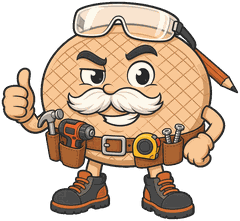
Meet Barry Biscuit, the AI joiner mate.
Barry is a made-up old joiner, named after the biscuit joint. Ask him a trade question. He answers in simple English, step by step. And he tells you when to ask a real tradie. Coming soon: experienced tradies help check his answers.
My cabinet door is sagging. How do I fix it?

Try:Door is saggingDrawer won't closeScribe an end panelScribe a benchtopClient plan vs siteLevel on a bad floor
AI beta: Barry is an AI and can be wrong. Always check with your supervisor and the maker's instructions.
One practical AI tip every week. Free.